
Introduction
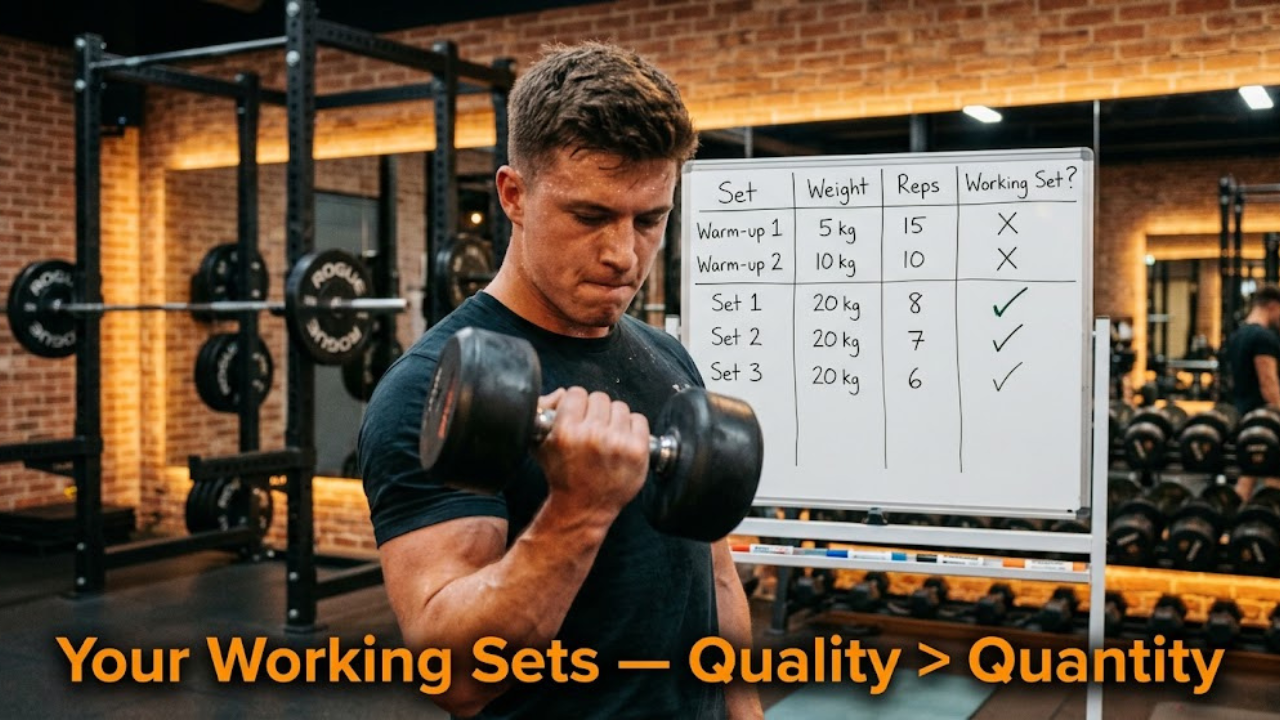
You walk into the gym, grab a bench, and knock out four sets of ten reps on the chest press. But were all those sets actually doing anything for you? Here’s the hard truth: your first two sets might have been warm-ups, and only the last two counted as real working sets. If you don’t know the difference, you’re probably wasting half your workout.
A working set is any set that’s challenging enough to stimulate muscle growth or strength gains. It’s the set that actually works — hence the name. Warm-up sets prepare your body. Working sets build it.
In this guide, you’ll learn exactly what counts as a working set, how many you need per muscle group, and how to structure them for maximum results. No fluff. Just the formula that turns gym time into real progress.
Table of Contents
-
What Is a Working Set?
-
Why Does the Working Set Matter?
-
Working Set — Key Facts, Types & How It Works
-
How To Use Working Sets in Your Workout
-
Common Mistakes & Myths to Avoid
-
Expert Tips for Best Results
-
Frequently Asked Questions
What Is a Working Set?
A working set is a set performed with enough intensity — weight, reps, or both — to create a meaningful training stimulus. In plain English: it’s the set that actually makes your muscles work hard enough to grow or get stronger.
Warm-up sets don’t count. Feeder sets don’t count. Only the sets where you’re pushing close to failure, lifting at a challenging weight, and intentionally creating fatigue count as working sets.
Think of it like studying for an exam. Reading the textbook once is your warm-up. Doing practice problems until you struggle — that’s your working set. The struggle is where the learning happens. Same with lifting: the challenge is where the growth happens.
Most workouts structure working sets after warm-ups. You warm up with light weight, then jump to your working weight and perform multiple working sets to get the bulk of your training volume. These sets are typically performed at 65–85% of your top effort or taken to within 1–2 reps of failure.
Why Does the Working Set Matter?
If you’re not tracking your working sets, you’re flying blind. Here’s why they matter:
-
They drive muscle growth. Only challenging sets trigger hypertrophy. A 2025 study found that muscle growth benefits increase up to about 11 working sets per muscle group per session. Below that threshold, you’re not giving your muscles enough reason to adapt.
-
They build strength. For strength gains, the sweet spot is even smaller — as few as 2 direct working sets per muscle group per session. Quality beats quantity every time.
-
They prevent overtraining. Tracking working sets helps you manage fatigue. Research suggests doing more than 10–11 working sets per muscle group in a single workout doesn’t produce additional growth. More isn’t better — smarter is.
-
They let you measure progress. When you log your working sets — weight, reps, and how hard each set felt — you get real data. You can see strength increases week to week without guessing.
-
They save time. Instead of doing 6 mediocre sets, you can do 3 solid working sets and get better results in half the time. Efficiency wins.
Working Set — Key Facts, Types & How It Works

The Three Set Types You Need to Know
Not all sets are created equal. Here’s how working sets fit into the bigger picture:
Top Sets are your heaviest lift of the day — typically 1–5 reps at 85–100% of your 1RM. They test your strength and prime your nervous system.
Working Sets (also called back-off sets) come after the top set. You drop the weight to 65–85% and perform multiple sets with the same reps. These build volume, reinforce technique, and accumulate the bulk of your training stimulus.
Straight Sets are uniform — same weight, same reps, same everything, set after set. Common in bodybuilding for accessory work.
Comparison Table: Top Sets vs Working Sets vs Straight Sets
| Feature | Top Set | Working Set | Straight Set |
|---|---|---|---|
| Intensity | 85–100% of 1RM | 65–85% of top effort | Moderate, fixed |
| Reps | 1–5 | Usually 3–8+ | Fixed (e.g., 3×10) |
| Purpose | Test strength, prime CNS | Build volume, reinforce form | Hypertrophy, endurance |
| When to use | Start of main lift | After top set | Accessory work |
| Fatigue impact | High | Moderate | Low to moderate |
How Many Working Sets Do You Actually Need?
For hypertrophy (muscle growth): Aim for 10–20 working sets per muscle group per week. Spread across 2–3 sessions, that’s roughly 3–6 working sets per muscle group per workout.
For strength: 3–6 working sets per muscle group per week at >80% 1RM is sufficient. That’s just 1–2 working sets per session if you train 2–3 times weekly.
Key insight: A 2021 study concluded that 3–6 weekly working sets of 1–5 reps at high intensity are enough to drive 1RM improvements in trained lifters. You don’t need to destroy yourself every session.
How To Use Working Sets in Your Workout
Follow these steps to nail your working sets every time:
Step 1: Warm up properly. Do 2–4 warm-up sets with increasing weight and decreasing reps. Start with the empty bar, then add weight in increments. Never count warm-ups as working sets.
Step 2: Pick your working weight. Choose a load you can lift for your target rep range with 1–2 reps left in the tank (RIR 1–2). If you’re doing 10 reps, the weight should make rep 8 feel hard and rep 10 feel like a grind.
Step 3: Perform your first working set. Go hard but controlled. Stop when form starts to break or you hit your target reps. Log the weight and reps.
Step 4: Rest adequately. Between working sets, rest 60–90 seconds for hypertrophy, 3–5 minutes for strength. Shortchanging rest kills your next set’s quality.
Step 5: Repeat for 3–5 working sets per exercise. For most lifts, 3–5 working sets is the sweet spot. If you’re doing more than 5, ask yourself: are these actually challenging, or just junk volume?
Step 6: Track everything. Write down weight, reps, and how each set felt. Use that data to adjust next week’s weight. Progressive overload is how you grow — and you can’t progress what you don’t measure.
Step 7: Re-evaluate every 4–6 weeks. As you get stronger, your working weight should increase. If you’re hitting the same weight for the same reps for weeks, it’s time to add load.
Common Mistakes & Myths to Avoid
Mistake #1: Counting warm-up sets as working sets. Warm-ups prepare you. Working sets challenge you. If you log 15 sets but only 6 were actually hard, you’re overestimating your volume and underestimating your recovery needs.
Myth #2: “You need 20+ sets per muscle group to grow.” Research shows that benefits max out around 10–11 working sets per session. Beyond that, you’re just accumulating fatigue without extra gains.
Mistake #3: Doing the same weight for all working sets. Straight sets work for accessories, but for main lifts, consider ramping or using top sets + back-off sets. Your first working set might be heavier than your last — and that’s fine.
Mistake #4: Not going hard enough. A working set should feel like work. If you finish and think “I could do that again easily,” it wasn’t a working set — it was a warm-up. Push to within 1–2 reps of failure.
Myth #5: “More working sets always = more gains.” For strength, 3–6 weekly working sets per lift is the minimum effective dose. For hypertrophy, 10–20 weekly sets is plenty. Quality and consistency beat volume every time.
Expert Tips for Best Results
-
Use RPE or RIR to gauge intensity. Rate each working set on a scale of 1–10 (RPE) or track how many reps you had left (RIR). Aim for RPE 7–9 or RIR 1–2.
-
Prioritize your first working set. You’re freshest on set one. Make it count. If you’re doing 4 sets, set 1 should be your strongest, not your weakest.
-
Increase weight when you hit the top of your rep range. If your program says 8–12 reps and you hit 12 on your first working set, add weight next session.
-
Spread volume across the week. Instead of 15 working sets for chest in one day, do 6 on Monday, 5 on Wednesday, 4 on Friday. Your muscles grow during recovery, not during the workout.
-
Log your working sets, not your warm-ups. Track only the sets that matter. Clean data = better decisions.
Frequently Asked Questions
What counts as a working set?
A working set is any set performed with sufficient intensity to stimulate adaptation — typically within 1–2 reps of failure, at 65–85% of your 1RM, and excluding warm-up sets. If you finish and feel like you could do it again easily, it wasn’t a working set.
What’s the difference between a set and a working set?
A “set” is simply a group of consecutive reps. A working set is a specific type of set — one that’s challenging and contributes to your training stimulus. Warm-up sets, feeder sets, and technique work are sets, but they’re not working sets.
Should you do 3 or 4 working sets?
For most exercises, 3–5 working sets is the ideal range. for strength-focused lifts, 3 sets at high intensity works well. For hypertrophy, 4 sets at moderate intensity gives you more volume. Start with 3, add a 4th if you’re recovering well and want more volume.
Conclusion
Three things to remember:
-
A working set is any set that actually challenges you — warm-ups don’t count. Track only the sets that push you within 1–2 reps of failure.
-
You don’t need as many as you think. For strength, 3–6 weekly working sets per lift is enough. For growth, 10–20 weekly sets per muscle group hits the sweet spot.
-
Quality beats quantity every time. One great working set is worth five half-hearted ones. Push hard, log your numbers, and add weight when you can.
Start today. Look at your last workout — how many of those sets were actually working sets? If the number is lower than you thought, you just found your easiest path to better gains.
What’s your go-to number of working sets per exercise? Drop it in the comments.