
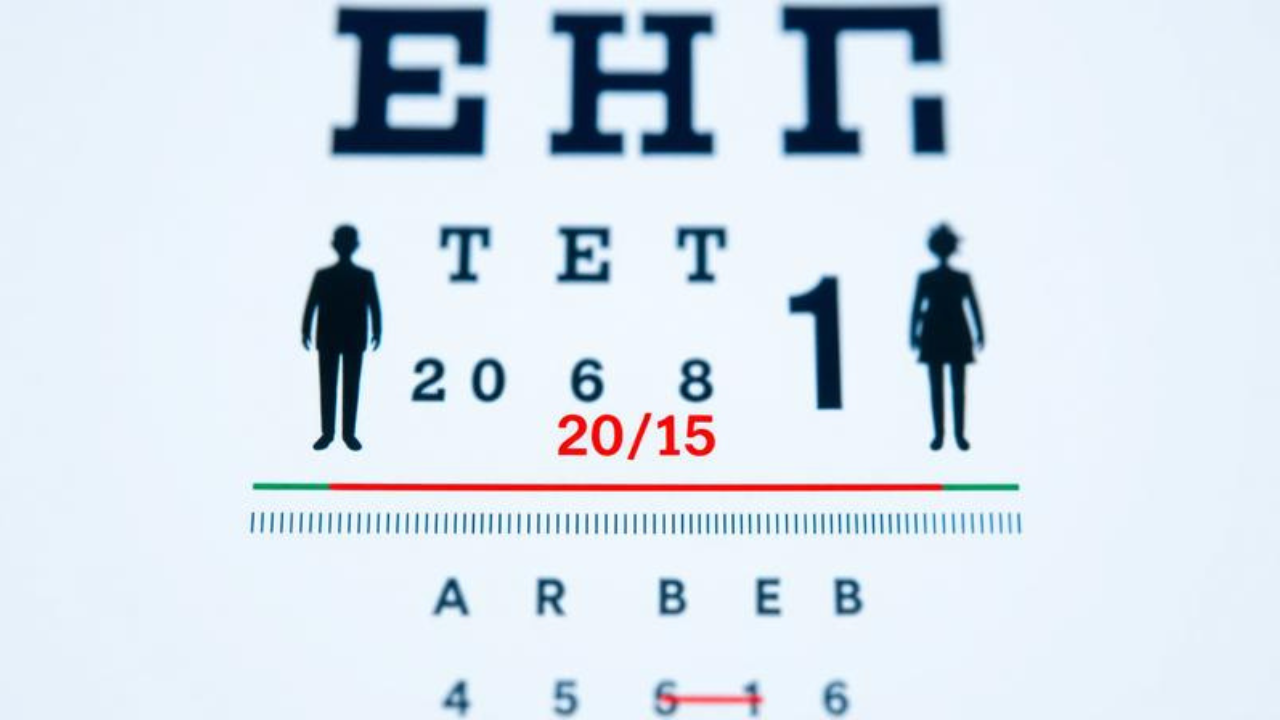
Most people have heard the phrase “20/20 vision” and assume it’s the gold standard—the pinnacle of human eyesight. But here’s the truth: 20/20 is simply average vision. It’s what eye doctors consider “normal” for the general population. However, millions of people actually see better than average. They possess what’s known as 20/15 eyesight—a level of visual clarity that allows them to spot fine details from distances that leave others squinting.
If you are curious about what 20/15 eyesight really means, how it compares to standard vision, whether it’s possible to achieve it naturally, or if you might already have it, you’ve come to the right place. In this comprehensive guide, we will unpack everything you need to know about this superior level of visual acuity.
What Does 20/15 Eyesight Actually Mean?
Let’s start with the basics. In the world of optometry, visual acuity is measured using fractions. The standard Snellen eye chart—the one with the big “E” at the top—helps determine these numbers.
The term 20/15 eyesight refers to the sharpness of your distance vision. Here is the simple breakdown:
-
The first number (20) is the distance in feet between you and the eye chart during testing.
-
The second number (15) is the distance at which a person with “normal” 20/20 vision would need to stand to see the same level of detail as you.
In other words, if you have 20/15 eyesight, you can stand 20 feet away from an object and see it as clearly as someone with standard vision can see it from only 15 feet away. That 5-foot advantage might not sound like much, but in real-world terms, it translates to noticeably sharper vision at greater distances. You can read road signs sooner, spot wildlife from farther away, and pick out details that others simply miss.
Visual Acuity at a Glance
To put this into perspective, here is how different acuity levels compare:
| Visual Acuity | What It Means |
|---|---|
| 20/10 | Excellent. You see at 20 feet what others see at 10 feet. |
| 20/15 | Better than average. You see at 20 feet what others see at 15 feet. |
| 20/20 | Normal / average vision. |
| 20/40 | Below average. You need to be at 20 feet to see what others see at 40 feet. |
| 20/200 | Legal blindness. |
It’s important to note that 20/15 eyesight is not necessarily “perfect” (there is even sharper vision, like 20/10 or 20/5), but it is excellent and well above the population norm.
20/20 vs. 20/15: Why Better Is Possible
A common misconception is that 20/20 represents perfect vision. In reality, it simply represents standard or average vision—the baseline against which all other visual acuity is compared. When optometrists say you have 20/20 vision, they are simply saying that your eyesight falls within the normal range.
20/15 eyesight goes a step beyond average. Imagine two people standing on a beach. A person with 20/20 vision looks out at a distant boat and can make out its general shape. Someone with 20/15 eyesight looks at that same boat and can see the name written on its hull or the people moving on the deck.
Who Naturally Has 20/15 Eyesight?
While 20/20 is considered standard, a surprising number of people naturally see better than 20/20. Research and clinical observations show that about two out of three people—roughly 66% of the population—are capable of seeing 20/15 with proper optical correction. This means that many individuals have the potential for sharper vision, even if they currently wear glasses or contact lenses.
Certain groups tend to have naturally superior visual acuity:
-
Young children and adolescents: Younger eyes tend to be more flexible and capable of higher acuity.
-
Individuals with healthy, unstrained vision: Those who maintain good eye habits.
-
Certain professionals: Military jet pilots, particularly fighter pilots, are often required to have (or achieve through correction) no worse than 20/15 vision. Historical studies on U.S. Navy pilots have established 20/15 as a benchmark for elite visual performance.
Can You Achieve 20/15 Eyesight?
This is the million-dollar question. Can someone with standard 20/20 vision train their eyes to see at a 20/15 level? The answer is nuanced.
Through Corrective Lenses
Yes, for most people, achieving 20/15 eyesight is absolutely possible. If your eyes are otherwise healthy, an optometrist can often prescribe glasses or contact lenses that push your visual acuity beyond the 20/20 baseline. This is particularly common in refractive surgery consultations, where laser eye surgery (LASIK, PRK, or SMILE) is often capable of correcting a patient to 20/15 or even 20/10. If you are considering surgery, be sure to ask your surgeon about their success rates for achieving “better than 20/20” outcomes.
Naturally Without Correction
This is where the waters get murkier—and where a lot of misinformation exists online. Can you improve your eyesight from 20/20 to 20/15 naturally using eye exercises or dietary changes?
The short answer is: it depends on the underlying cause of any existing vision issues. If your eyes are structurally healthy and you simply experience occasional eye strain or minor focusing problems, certain habits may help.
Many proponents of natural vision improvement recommend techniques such as:
-
Focus shifting exercises: Alternating focus between a near object and a distant object.
-
The 20-20-20 rule: Every 20 minutes, look at something 20 feet away for 20 seconds to reduce ciliary muscle fatigue.
-
Palming: Covering your closed eyes with warm hands to induce deep relaxation.
However, it is crucial to distinguish between relaxation techniques and changing the physical shape of your eye. Refractive errors like myopia (nearsightedness) are typically caused by the physical length of the eyeball being too long or too short. No amount of blinking or palming can physically alter the axial length of your eye. While natural techniques can certainly reduce strain, optimize your existing vision, and help maintain health, they are unlikely to take someone from significant visual impairment to superior 20/15 acuity.
The real value of natural eye care lies in maintenance: eating a diet rich in vitamins A, C, and E, protecting your eyes from UV radiation, and reducing digital eye strain.
20/15 Eyesight in the Professional World
Having superior vision is not just a party trick; for some careers, it is a distinct professional advantage—and sometimes a requirement.
Military and Aviation
Elite military pilots, particularly those flying high-performance jets like the F-35 or F-22, often require visual acuity that meets or exceeds the 20/15 standard. While the general military standard often allows for correctable 20/20 vision, specific special operations and pilot pipelines have historically used 20/15 as the benchmark for uncorrected or corrected superior vision.
Professional Sports
In sports like baseball, tennis, and soccer, milliseconds matter. Players with 20/15 eyesight or better have a distinct advantage in tracking fast-moving balls, reading the spin, and judging distances compared to those with standard 20/20 vision. Many professional athletes undergo rigorous vision training to maximize their visual processing speed and acuity.
Law Enforcement and Trades
Snipers, detectives, and specialized units within law enforcement value candidates with naturally superior distance vision for surveillance and precision work.
How Is 20/15 Eyesight Tested?
You cannot determine if you have 20/15 eyesight just by glancing out a window. It requires a standardized visual acuity test, most commonly using a Snellen chart or a digital equivalent.
During a routine eye exam, you will be asked to read lines of letters that get progressively smaller. The 20/15 line typically appears near the very bottom of the chart, below the larger 20/20 line. If you can correctly identify most or all of the letters on that line, you have demonstrated 20/15 visual acuity in that eye.
Important note: Online eye tests can give you a rough indication, but they are no substitute for a comprehensive, in-person examination by an optometrist or ophthalmologist. Factors like lighting, screen resolution, distance calibration, and refraction (focus) can only be accurately measured in a clinical setting.
How to Maintain Healthy 20/15 Eyesight
If you are fortunate enough to have excellent vision—or even if you’re working toward optimizing it—maintenance is key. Here are evidence-backed practices to keep your eyes in peak condition:
-
Wear UV protection: Sun exposure increases the risk of cataracts and macular degeneration.
-
Follow the 20-20-20 rule for screens: Take a 20-second break to look 20 feet away every 20 minutes.
-
Eat for your eyes: Prioritize leafy greens (lutein/zeaxanthin), fatty fish (omega-3s), and colorful vegetables (vitamins A, C, and E).
-
Manage chronic conditions: Diabetes and high blood pressure can significantly affect your vision if left uncontrolled.
-
Get regular comprehensive eye exams: Even if you think your vision is perfect, annual exams can detect silent eye diseases like glaucoma before they cause permanent damage.
Common Myths About Superior Eyesight
Let’s clear up a few misconceptions:
-
Myth: 20/20 is perfect.
Fact: 20/20 is average. Many people see better, and some animals (like eagles) have vision estimated at 20/5. -
Myth: Eye exercises can cure all vision problems.
Fact: They can reduce strain and optimize focus, but they cannot cure structural refractive errors like high myopia. -
Myth: If you have 20/15, you never need an eye exam.
Fact: Even people with excellent distance vision can develop eye diseases. Regular checkups are essential for long-term eye health.
Summary: Is 20/15 Eyesight Right for You?
Whether you are born with superior eyesight, achieve it through cutting-edge refractive surgery, or simply work to protect the vision you already have, 20/15 eyesight represents a tangible upgrade in the quality of your daily life. From spotting wildlife on a hike to reading a menu across a noisy restaurant, having that extra 5 feet of clarity changes how you interact with the world.
If you have never had an eye exam beyond a simple driver’s license test, or if it has been more than two years since your last comprehensive checkup, now is the time to see an optometrist.
Ready to See What You’ve Been Missing?
If this guide sparked your curiosity, don’t stop here. Excellent vision isn’t just luck—it’s the result of proactive care and professional oversight.
Call to Action: Have you ever been told you have better than 20/20 vision? Do you have questions about LASIK, natural vision improvement, or the specific requirements for a career in aviation? Drop a comment below and share your experience. If you are ready to find out your true visual potential, schedule a comprehensive eye exam with a licensed optometrist today. It might just reveal that you’ve been seeing the world with 20/15 eyesight all along—and didn’t even know it. 👁️