

Introduction
You walk into the gym, see someone load up a barbell with way more weight than you’d ever try, and they grind out one slow, shaky rep. You wonder: how do they know their true max? The answer isn’t guessing or ego-lifting. It’s math. Specifically, it’s the Brzycki formula — a simple equation that estimates your one-rep max (1RM) from a submaximal set you already did.
Here’s the bold truth: you don’t need to test your true 1RM to know your true 1RM. Testing a max lift carries injury risk and requires days of recovery. The Brzycki formula gives you a safe, research-backed estimate that’s accurate enough to program your entire training block.
In this guide, you’ll learn exactly what the Brzycki formula is, how to use it, how it stacks up against the Epley formula, and how to avoid the mistakes most lifters make when estimating their max. By the end, you’ll know your 1RM without ever attempting a risky heavy single.
Table of Contents
-
What Is the Brzycki Formula?
-
Why Does the Brzycki Formula Matter?
-
Brzycki Formula — How It Works & Key Comparisons
-
How To Use the Brzycki Formula Calculator
-
Common Mistakes & Myths to Avoid
-
Expert Tips for Best Results
-
Frequently Asked Questions
What Is the Brzycki Formula?
The Brzycki formula is a mathematical equation that estimates your one-rep maximum (1RM) — the heaviest weight you can lift for a single repetition with proper form — based on how much weight you lifted and how many reps you completed in a submaximal set.
The formula looks like this:
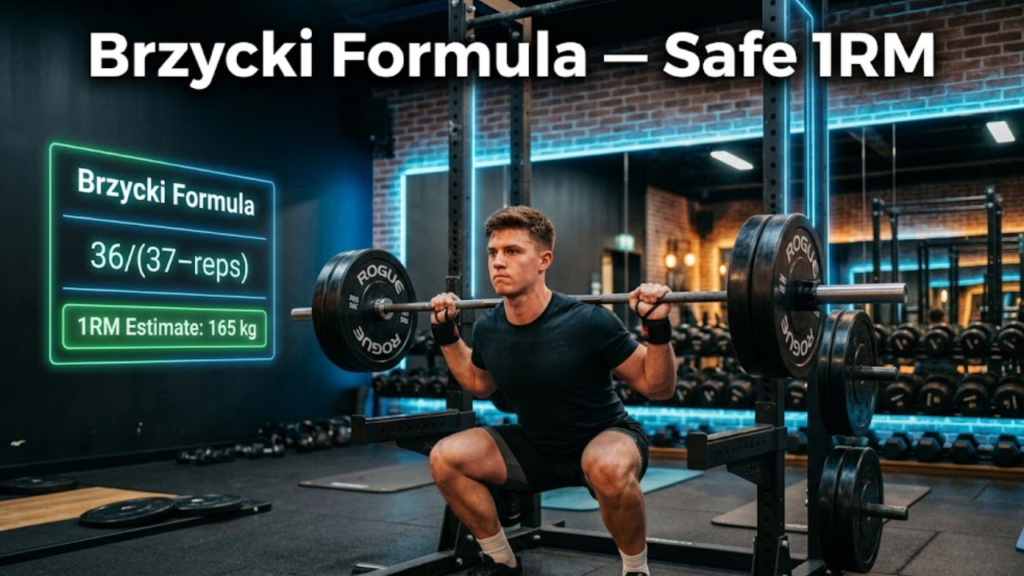
1RM = weight × (36 ÷ (37 − reps))
Here’s what that means in plain English: take the weight you lifted, multiply it by 36, then divide that number by 37 minus the number of reps you did.
Real-world example: You bench press 100 kg for 5 reps with good form. Plug that into the formula: 100 × (36 ÷ (37 − 5)) = 100 × (36 ÷ 32) = 112.5 kg estimated 1RM.
Matt Brzycki, the guy behind this formula, was Princeton University’s Assistant Director of Campus Recreation and Fitness. He published this equation in 1993 as a safer alternative to direct max testing. Instead of risking injury on a heavy single, you can push a moderate weight to near-failure and let the math do the heavy lifting.
Think of it like this: if your 5-rep max is 100 kg, the formula works backward to figure out what you could theoretically do for one rep. It’s not perfect — no estimate is — but it’s accurate within 5–10% for most people on 2–8 rep sets.
Why Does the Brzycki Formula Matter?
If you’re serious about getting stronger, you need to know your numbers. The Brzycki formula isn’t just gym math — it’s the foundation of smart programming. Here’s why it matters:
-
Safety first. Testing a true 1RM puts massive stress on your muscles, joints, and nervous system. The Brzycki formula lets you estimate your max from a submaximal set, cutting injury risk dramatically.
-
Program your training. Most strength programs prescribe weights as a percentage of your 1RM. Once you know your estimated max, you can calculate exactly what to load for every set — 90% for heavy singles, 80% for strength work, 70% for volume.
-
Track progress without peaking. You don’t need to “peak” every time you want to measure strength gains. Re-estimate your 1RM every 4–8 weeks using the formula and watch your numbers climb.
-
It’s research-backed. Studies show the Brzycki formula is among the most accurate 1RM prediction methods, especially for sets of 10 reps or fewer.
-
Removes guesswork. No more wondering, “What’s my actual max?” You get a concrete number you can trust — and adjust — based on real performance data.
One stat to remember: In a validation study, the Brzycki equation showed no statistically significant difference between estimated and actual 1RM values (P > 0.05), with a coefficient of error as low as 0.3%. That’s impressive for a math formula.
Brzycki Formula — How It Works & Key Comparisons
The Math Behind It
The Brzycki formula uses an exponential curve that becomes steeper as your rep count approaches the theoretical maximum of 37 reps. This means:
-
At 1 rep: The formula returns exactly the weight you lifted (1RM = weight × (36/36) = weight).
-
At 5 reps: 1RM = weight × 1.125 (a 12.5% increase).
-
At 10 reps: 1RM = weight × 1.333 (a 33% increase).
The formula works best when you use a weight you can lift for 2 to 8 reps with good form. Accuracy drops significantly above 10 reps because fatigue and endurance start to skew the numbers.
Brzycki vs Epley: Which One Should You Use?
The Epley formula is the other big player in the 1RM estimation game. Here’s the equation: 1RM = weight × (1 + reps/30).
So how do they compare?
| Feature | Brzycki Formula | Epley Formula |
|---|---|---|
| Year introduced | 1993 | 1985 |
| Equation | weight × (36 / (37 − reps)) | weight × (1 + reps/30) |
| Best rep range | 1–6 reps | 6–10 reps |
| At 5 reps (100 kg) | 112.5 kg | 116.7 kg |
| Vibe | More conservative | Slightly more optimistic |
| Popularity | Common in US strength research | Most widely cited globally |
What does this mean for you? For 1–5 reps, both formulas agree within 2–3%. At higher rep ranges, Epley tends to give a slightly higher estimate while Brzycki stays more conservative.
If you’re following an NSCA-certified program, they often specify Brzycki. If you’re using most commercial apps, Epley is usually the default. The smart move? Average both estimates for a balanced number.
Other 1RM Formulas You Might See
-
Lombardi: 1RM = weight × reps^0.10 — tends to overestimate at higher reps
-
Mayhew: More complex, good for 6–20 reps
-
O’Conner: 1RM = weight × (1 + 0.025 × reps) — conservative, good for beginners
For 90% of lifters, Brzycki and Epley are all you need.
How To Use the Brzycki Formula Calculator
Using the Brzycki formula calculator is straightforward. Follow these steps to get an accurate 1RM estimate:
Step 1: Choose your exercise. The formula works best for compound barbell lifts — squat, bench press, deadlift, and overhead press. Isolation exercises produce less reliable estimates because stabilization demands vary.
Step 2: Warm up properly. Do 2–3 light warm-up sets to prepare your muscles and nervous system. Never jump straight into a heavy set cold.
Step 3: Select a weight you can lift for 2–8 reps. This is the sweet spot for accuracy. If you can do more than 10 reps, the weight is too light — go heavier. If you can’t hit 2 reps, it’s too heavy.
Step 4: Perform the set to near-failure. Push hard, but maintain proper form. The formula assumes you went to or near muscular failure. Stopping too early will underestimate your 1RM.
Step 5: Plug your numbers into the formula. Take the weight you lifted and the number of reps completed. Calculate: 1RM = weight × (36 ÷ (37 − reps)).
Example: You squat 140 kg for 4 reps. 1RM = 140 × (36 ÷ 33) = 140 × 1.091 = 152.7 kg.
Step 6: Use the percentage table to program your training. Once you have your estimated 1RM, multiply it by the percentages below to get your working weights:
| Intensity | Reps | Purpose |
|---|---|---|
| 90–95% | 1–3 | Maximum strength, peaking |
| 80–89% | 3–5 | Heavy strength work |
| 70–79% | 5–8 | Strength + hypertrophy |
| 60–69% | 8–12 | Hypertrophy focus |
| 50–59% | 12+ | Technique, warm-ups, deload |
Step 7: Recalculate every 4–8 weeks. As you get stronger, your 1RM goes up. Update your numbers regularly to keep your training on track.
Common Mistakes & Myths to Avoid
Mistake #1: Using a set with more than 10 reps. The Brzycki formula loses accuracy above 10 reps because endurance factors start dominating. Stick to 2–8 reps for the best estimate.
Myth #2: “Brzycki and Epley give totally different results.” They actually agree within 2–3% for 1–5 reps. The difference only becomes noticeable at higher rep ranges, where Brzycki is more conservative.
Mistake #3: Stopping well short of failure. The formula assumes you pushed to near-failure. If you leave 2–3 reps in the tank, your estimate will be too low. Be honest with yourself about how hard you actually went.
Myth #4: “The formula works for every exercise equally.” It doesn’t. Compound lifts (squat, bench, deadlift) are more predictable than machine exercises or dumbbell work.
Mistake #5: Testing your 1RM every week. Your estimated max doesn’t change that fast. Recalculate every 4–8 weeks, not every session. Chasing a new “max” weekly leads to burnout and injury.
Expert Tips for Best Results
-
Average multiple formulas. Use both Brzycki and Epley, then average them. This cancels out individual formula bias and gives you a more balanced estimate.
-
Use the same formula consistently. Pick Brzycki or Epley and stick with it for tracking progress. Switching formulas mid-program makes it hard to compare gains.
-
Test on well-rested days. Fatigue, sleep quality, and nutrition can shift your actual performance by 5–10% day to day. Test when you’re fresh.
-
Log your sets. Write down the weight, reps, and date. Track your estimated 1RM over time to see real progress without guessing.
-
Reserve true 1RM testing for competition prep. For everyday training, the Brzycki formula is more than accurate enough. Save the heavy singles for when it actually counts.
Frequently Asked Questions
How many reps is 90% of 1 rep max?
90% of your 1RM typically corresponds to 2–4 reps for most lifters, depending on the exercise and your training experience. For compound lifts like squat and bench, expect around 3 reps at 90%. For smaller muscle groups, you might get 4–5 reps. Use this as a general guide — individual variation is normal.
How accurate is the Epley formula?
The Epley formula is highly accurate for 1–10 rep sets, with one study showing a mean difference of just 3.30 kg between estimated and actual 1RM. It’s the most widely cited 1RM formula in strength research. For moderate rep ranges (6–10), Epley and Brzycki perform similarly well.
Which 1RM formula is most accurate?
No single formula is universally the most accurate. Brzycki is most accurate for 1–6 reps, while Epley works best for 6–10 reps. For the best results, use both and average them. Research shows the Brzycki equation was the most accurate for subjects completing 10 or fewer reps to failure.
Conclusion
Three things to take away:
-
The Brzycki formula gives you a safe, research-backed way to estimate your 1RM without the injury risk of max testing. It’s accurate within 5–10% for most people on 2–8 rep sets.
-
Brzycki and Epley are both solid choices — they agree closely at low reps. Use Brzycki for 1–6 reps, Epley for 6–10 reps, or average them for a balanced estimate.
-
Knowing your 1RM transforms your training. You can program precise percentages, track progress objectively, and stop guessing what to load on the bar.
Start today. Pick an exercise, choose a weight you can lift for 5 clean reps, plug it into the Brzycki formula calculator, and get your real max — without the risk.
What’s your current estimated 1RM on bench, squat, or deadlift? Drop it in the comments and let’s compare.