
Introduction
Would you trust a robot arm to pull your morning espresso? Thousands of people already do, and the coffee robot brands behind those drinks are multiplying fast. Names like Cafe X, Artly, Rozum, and KUKA keep popping up, yet each one plays a very different game.
Some companies sell you a finished coffee kiosk. Others run their own cafés, and one supplies the industrial arms that other builders use. That mix confuses most people, and it makes comparing the brands harder than it should be.
This educational guide from deepfreezechillin.com sorts it all out in plain English. You will learn what each brand actually does, how they differ, who their main competitors are, and how to judge any robot barista in 2026. You need no engineering degree, just curiosity and a love of good coffee. Along the way, you will also spot the marketing claims that deserve a second look.
Table of Contents
- What Are Coffee Robot Brands?
- Why Do Robot Barista Brands Matter?
- Robot Barista Brands Compared: Cafe X, Artly, Rozum, KUKA
- How to Compare Robotic Barista Systems
- Common Mistakes and Myths About Robot Baristas
- Expert Tips for Judging Robotic Coffee Kiosks
- Frequently Asked Questions About Robot Baristas
What Are Coffee Robot Brands?
Coffee robot brands are companies that build or run machines where a robotic arm, not a person, makes your drink. Most use a six-axis robotic arm, a jointed arm that moves much like a human shoulder, elbow, and wrist. Cameras, sensors, and software tell the arm when to grind, tamp, steam, and pour.
Think of a car factory. A welding robot repeats one motion perfectly all day, and a robot barista does the same with coffee. The difference is that a latte has many more steps, so the software must coordinate the espresso machine, the milk, and the cup.
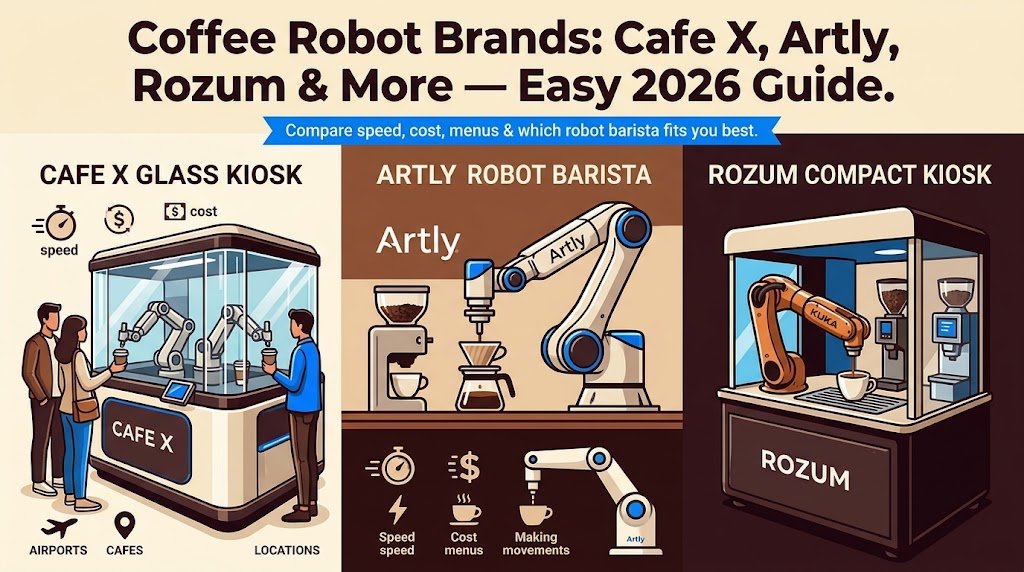
Not every brand sells the same thing. Cafe X and Artly operate robotic cafés, Rozum sells a ready-made robotic coffee kiosk, and KUKA builds the industrial robots that power other companies’ bars. Knowing that difference is the first step to comparing them.
Why Do Robot Barista Brands Matter?
The trend is growing quickly. Researchandmarkets values the robotic café market at about $2.18 billion in 2026, with a projected 16.8% yearly growth rate, as reported by Accio. Money is following the idea, and that shapes which brands survive. Here is why that matters to you:
- Consistency: A robot repeats the same recipe every time, so your latte tastes the same at 7 a.m. and 7 p.m.
- Speed: Some systems make a drink in about a minute, which helps in busy airports and stations.
- Long hours: Rozum says its kiosk can serve places that never sleep, such as hospitals and rail stations.
- Small footprint: Artly claims one of its shops needs about one-fifth of the space of a Starbucks.
- Data: Online sales statistics show which drinks customers order most often.
- Entertainment: Watching an arm make your coffee turns a quick stop into a memory, which is why cafés use robots to draw crowds.
Robot Barista Brands Compared: Cafe X, Artly, Rozum, KUKA
Each brand solves a different problem. Here is how they stack up.
Cafe X
Cafe X started in San Francisco and put a six-axis arm inside a glass kiosk. Early coverage described a design aimed at about 120 cups per hour, and Modern Retail now describes its kiosks in airports and museums. You order by app or tablet and watch the robot work.
Artly
Artly runs cafés in Seattle and other cities and reports about 11 locations across the US and Canada. Its robots learn through imitation learning: engineers track a champion barista’s hands, then teach the robot to copy every move. A human always works on site.
Rozum Café
Rozum Café is a kiosk sold to business owners. A PULSE robot arm works with a Nuova Simonelli espresso machine, and the company says it needs no water or sewage connection. Rozum claims 400+ cups a day and about 90 seconds per espresso.
KUKA
KUKA is an industrial robot maker, not a coffee shop. Its KR AGILUS arms power Ratio, a robotic café and bar in Singapore that ordered 16 café arms and four bar arms in 2021. KUKA has also shown a kiosk that makes an Americano in 45 seconds.
Other Competitors
Richtech Robotics (ADAM), Doosan Robotics, and Crown Digital also compete for attention. ADAM serves drinks at Clouffee & Tea in Las Vegas.
| Brand | Type | Business Model | Standout Detail |
|---|---|---|---|
| Cafe X | Robotic kiosk | Operates and sells kiosks | Glass kiosk, six-axis arm |
| Artly | Robotic cafés | Runs cafés, partners with businesses | Imitation learning |
| Rozum Café | Kiosk for sale | Sold to owners | 400+ cups per day claim |
| KUKA | Robot supplier | Sells industrial arms | Powers Ratio in Singapore |
| Richtech ADAM | Two-armed robot | Leases robots, runs a café | Recognizes customers |
How to Compare Robotic Barista Systems
Whether you want to visit, partner with, or buy from one of these brands, follow these steps:
- Define your goal. Decide if you want a great cup of coffee, a business, or a crowd-pleasing showpiece. Your goal narrows the list fast, and it keeps you from paying for features you will never use.
- Pick your model. Some brands run cafés you can visit, some sell kiosks, and others supply parts. Match the brand type to your need, so you do not call a robot supplier when you want a latte.
- Check the menu. Look at the drinks each robot makes, from espresso to cold brew or milk drinks. A short menu can limit your sales or your options, and hot-only systems miss iced-drink fans.
- Ask about space and hookups. Rozum says its kiosk needs no water line, but other systems may differ. Confirm power, plumbing, and floor space before you commit. A survey visit can save you a costly surprise.
- Verify speed claims. Companies quote cups per hour or seconds per drink under ideal conditions. Ask for a live demo or visit a working location and time it yourself. Note how long you wait during a busy hour, and count the cups.
- Total the true cost. One market overview lists prices from $15,000 to $60,000+ per unit, before maintenance. Ask about service plans, staff training, and daily upkeep. Add those costs to the sticker price before you decide.
Common Mistakes and Myths About Robot Baristas
- Myth: Robots remove every human. The truth: Artly keeps at least one person on site, and Cafe X has used greeters to explain how the process works. Humans still handle service and restocking.
- Mistake: Treating KUKA like a coffee brand. The truth: KUKA sells robots, and other companies, such as Ratio in Singapore, design the café around them. Its arms are tools, not a menu.
- Mistake: Trusting spec sheets blindly. The truth: cups-per-hour numbers come from the companies themselves, so test them. A number from a brochure is a claim, not proof.
- Myth: Robot coffee equals vending-machine coffee. The truth: Artly and Rozum use professional espresso equipment and champion-tuned recipes, so the drink can taste like real specialty coffee.
- Mistake: Ignoring maintenance. The truth: Rozum says upkeep takes about 60 minutes per shift, so budget for it. A neglected robot makes worse coffee.
Expert Tips for Judging Robotic Coffee Kiosks
- Taste before you trust. Order a plain espresso and a milk drink, and judge both. Robots should nail the basics before you trust the fancy drinks.
- Watch the whole process. Look for spills, pauses, and cleaning steps between orders.
- Ask who the champion is. Artly and Rozum both credit prize-winning baristas for their recipes, so ask whom a brand credits.
- Compare at peak hours. A robot that looks fast at noon on a quiet day may slow down at rush hour.
- Read recent reviews. Brands change quickly, so check 2026 feedback, not 2018 press. A company that expanded or changed models will look very different today.
Frequently Asked Questions About Robot Baristas
Which company makes the best coffee robot?
No single winner exists, because each brand targets a different need. Artly suits people who want to visit a robotic café, Rozum and Cafe X suit business owners who want a kiosk, and KUKA suits builders who need industrial arms. Start with your goal, then compare menus, speed, and support before you decide. A short visit to a working location will teach you more than any brochure.
How much does a robot barista cost?
Prices vary widely by brand and setup. One 2026 market overview lists $15,000 to $60,000+ per unit, and Cafe X’s early arm reportedly cost about $25,000 in 2018. Maintenance plans, leasing options, and installation change the final number, so always request a written quote from each company before you compare. Prices in old news stories may no longer apply, so always check current numbers.
Will robot baristas replace human baristas?
Not completely, at least today. Artly says its goal is to share a champion barista’s skills in more places, and it keeps a person on site. Robots handle repeat tasks well, while people handle customer service, cleaning, and surprises. Most brands so far use a hybrid model that pairs a robot arm with human staff. That balance may change as the technology improves.
Conclusion
Now you know how the leading coffee robot brands differ. Remember three points. First, Cafe X, Artly, Rozum, and KUKA are not identical, because they run cafés, sell kiosks, or supply robots. Second, most speed and cost figures come from the companies themselves, so verify them. Third, your goal should decide which brand fits.
Ready to see one in action? Visit a robotic café near you, order a simple espresso, and watch the arm work. You will learn more in five minutes than in an hour of reading.
Which robot barista would you try first, and what drink would you order? Tell us in the comments!